
Bleeding gums – a sign of gingivitis
Healthy gums do not bleed. If you see blood in the sink when you brush or floss, it is your body's signal that your gums are inflamed. The good news: in the early stages it can disappear completely.
What is happening?
Bacterial deposits (plaque) build up along the gum line every day. If they are not removed, the gums react with inflammation: they become red, swollen and bleed easily. This is called gingivitis. If plaque is left in place, it hardens into tartar, which you cannot brush off yourself.
Gingivitis or periodontitis?
Gingivitis affects only the gums and can clear up by itself once the teeth are clean again. If the inflammation continues for a long time, it can spread down to the bone that holds the teeth in place. This is periodontitis (paradentose), where the lost bone does not grow back. That is why it is wise to act early.
Practical advice
- Keep brushing – including where it bleeds. Use a soft toothbrush and brush along the gum line.
- Clean between your teeth every day. The bleeding typically subsides within one to two weeks once the area is clean.
- If you smoke, smoking can hide the bleeding even though the gums are inflamed.
- If you are pregnant, your gums are often extra sensitive – read dental care during pregnancy.
When should you see the dentist?
If your gums still bleed after a couple of weeks of thorough care, or you notice loose teeth, receding gums or persistent bad breath, you should have it examined. We remove tartar with a professional clean and measure whether pockets have formed around the teeth.
Need help?
Call 45 87 12 26 or book an appointment. New patients are welcome. Emergency toothache outside opening hours: Tandlægevagten (emergency dental service), Oslo Plads 14, København Ø, tel. 70 25 00 41.
This page gives general information and does not replace an examination by a dentist.
Reviewed by dentist Kenny Deneke Sørensen and dentist Anne Lytt Rahbek, Tandlægerne Lyngby Torv 1. Both qualified in 2002 from the School of Dentistry at the University of Copenhagen.
Questions and answers
Why do my gums bleed when I brush my teeth?
The most common cause is gingivitis, caused by bacterial plaque along the gum line. Thorough brushing and cleaning between the teeth often make it go away.
Should I stop flossing if my gums bleed?
No. The bleeding is a sign of inflammation, which disappears precisely when the area is cleaned every day.
What is the difference between gingivitis and periodontitis?
Gingivitis affects only the gums and can disappear completely. With periodontitis the inflammation has spread to the bone around the teeth, and the bone loss is permanent.
Related treatments
Periodontitis (gum disease)
Treatment of gum disease before it damages the bone.
Examination: 558,62 kr.Check-up and cleaning
A thorough examination of teeth and gums with digital X-rays and cleaning.
Check-up from age 26: 193,70 kr.Fillings
Tooth-coloured composite fillings for cavities and broken teeth.
From 497,00 kr.Night guard for teeth grinding
Relieves your teeth and jaw if you grind or clench your teeth.
Soft splint: 2.927,52 kr.Ready to book an appointment?
Call 45 87 12 26 during opening hours, or book online. New patients are welcome.
How to find us
Tandlægerne Lyngby Torv 1
Lyngby Torv 1, 1. th. (1st floor right)
2800 Kongens Lyngby
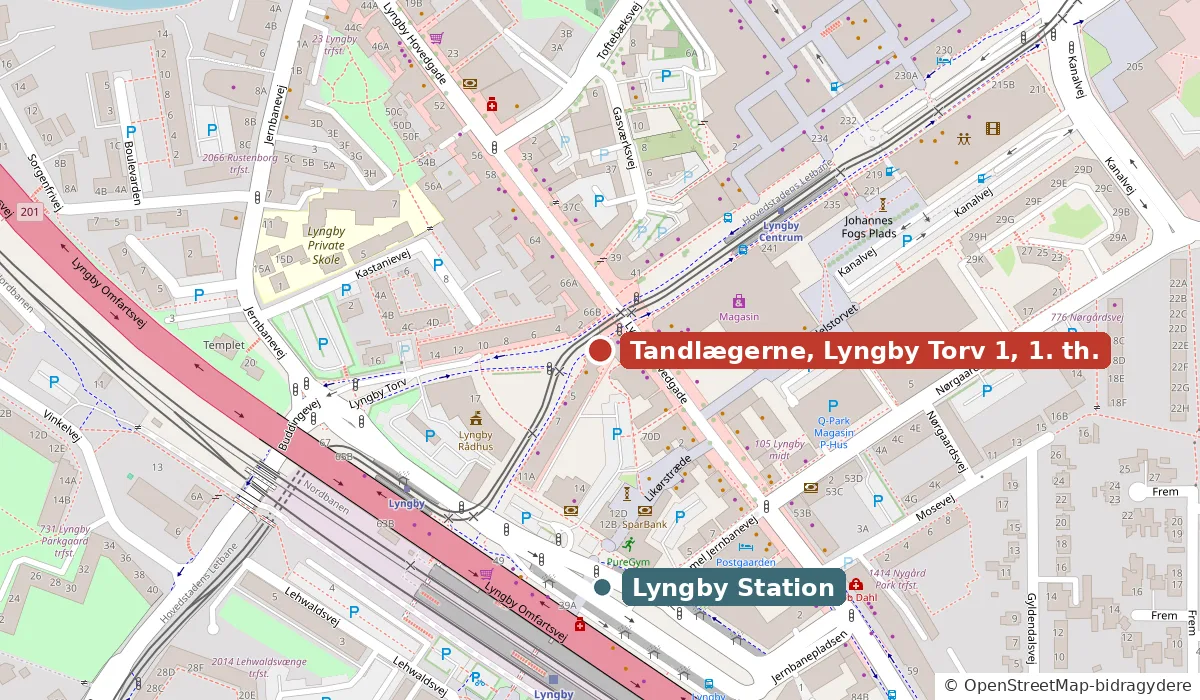
You will find us on the 1st floor, to the right, in the corner building on Lyngby Torv – in the centre of Kgs. Lyngby, facing Lyngby Hovedgade. There are stairs up to the clinic and no lift, and unfortunately there is no wheelchair access.
- Train and light rail: From Lyngby Station it is about 250 metres up to the square – a 3–4 minute walk.
- Bus: Many routes serve the bus terminal at Lyngby Station, including 184, 300S, 388 and 400S.
- Car: 2-hour parking around the clinic (remember your parking disc) and paid parking under Lyngby Storcenter and at Magasin.
- Need help? If you find stairs difficult, please call 45 87 12 26 before your visit.
The map is only loaded from Google when you tap. Google may then set cookies. Read more.
Image: © OpenStreetMap contributors