
Frequently asked questions
Here you will find answers to the most common questions about treatments, prices and your visit to Tandlægerne Lyngby Torv 1.
Questions and answers
What are the opening hours at Tandlægerne Lyngby Torv 1?
Monday–Wednesday 8.00–17.00, Thursday 8.00–16.00 and Friday 8.00–14.30.
Is there a lift or wheelchair access?
The clinic is on the 1st floor, and there is no lift – only stairs. Unfortunately, there is no wheelchair access either. If you find stairs difficult, please call 45 87 12 26 before your visit, and we will talk about what we can do.
Where can I park?
There is 2-hour parking around the clinic. On Lyngby Hovedgade there is only 30-minute parking. There is paid parking under Lyngby Storcenter and at Magasin.
What do I do about toothache outside opening hours?
Contact Tandlægevagten (the emergency dental service), Oslo Plads 14, København Ø, on 70 25 00 41. For severe toothache you can also contact lægevagten (the out-of-hours doctor service).
Which is better, a denture or an implant?
The choice between a denture and an implant depends on several factors, including your health, budget and comfort. A traditional denture can be a good choice if many teeth are missing or if the jawbone is not strong enough for implants. Dentures are typically a more affordable solution and can be made relatively quickly, although some people find they need adjusting or replacing over time. An implant, on the other hand, is a permanent solution in which a titanium screw is placed in the jawbone and acts as the “root” for a crown or bridge. Implants often feel more natural and are more secure, which can improve chewing and confidence. The procedure is more expensive, however, and requires sufficient bone quantity and quality. A thorough conversation with your dentist about your specific needs and wishes can help you make the right choice.
How does implant surgery work?
Implant surgery usually starts with a thorough preliminary examination and X-rays to assess the quality and quantity of the jawbone. If there is enough bone, the operation can be carried out after first thoroughly numbing the area. The dentist or surgeon then makes a small incision in the gum to access the jawbone. A hole is drilled and a titanium screw is placed to act as the new tooth root. The gum is then closed with stitches so the screw can fuse with the bone during a healing period that normally lasts from a couple of months up to six months. During this period the implant integrates with the bone so it becomes firmly anchored. When healing is complete, an abutment (a connecting piece) is attached, and finally the crown or bridge is mounted on the abutment. The result is a permanent solution that looks and works like a natural tooth.
What is teeth grinding?
Teeth grinding, also known as bruxism, is a condition in which you unconsciously grind or clench your teeth together, often at night. It can occur during periods of stress, anxiety or sleep disturbance, but the causes vary greatly from person to person. Some people do not realise they grind their teeth until a partner notices the sound or a dentist sees wear on the chewing surfaces. Persistent grinding can lead to jaw tension, headaches and even neck and shoulder pain. The teeth can also wear down over time, losing their natural shape and possibly cracking. Treatment may include a night guard, which relieves the teeth and jaw, along with efforts to reduce stress and relaxation techniques. In some cases exercises or physiotherapy can also help ease muscle tension and improve the jaw joint.
Is it normal to grind your teeth?
Teeth grinding is relatively common, and many people do it for shorter periods without knowing. Some grinding can be a normal reaction to stress or restlessness, especially during sleep when you are not aware of your jaw movements. However, it becomes a problem if the grinding is so strong or frequent that it wears the teeth abnormally or causes pain in the jaw joint. Frequent grinding can over time lead to headaches, muscle tension and tenderness. It is important to look out for symptoms that may indicate bruxism, including increased tooth sensitivity, jaw joint pain or unexplained tension in the face. If you notice these signs, a dental consultation can determine whether a night guard or other measures are needed. That way you can protect your teeth and ease any problems linked to grinding.
What is an exposed tooth nerve?
An exposed tooth nerve occurs when the tooth's protective layers – the enamel and the dentine underneath – have been damaged or broken down, so that the nerve inside the tooth (the pulp) is exposed. This can be caused by deep decay (cavities), a blow to the tooth, wear, or dental treatment in which the nerve is accidentally exposed. An exposed nerve is often very painful because the nerve is sensitive to hot and cold, sweet and sour. Many people feel a sharp, shooting pain that may be constant or occur in certain situations. If you suspect your tooth nerve is exposed, it is important to see a dentist quickly. Left untreated, it can lead to inflammation of the nerve (pulpitis) and in the worst case develop into a dental abscess. Treatment depends on the extent of the damage but may include root canal treatment, a filling or in some cases removal of the tooth.
Is teeth whitening bad for you?
Teeth whitening is generally safe when carried out correctly with the right products. However, we strongly recommend having your oral hygiene and the condition of your enamel assessed by a dentist before starting whitening. If you have your teeth whitened by your dentist, it is generally safe, because your dentist assesses how much whitening your teeth can tolerate. You may experience temporary side effects such as twinges or increased sensitivity to hot and cold, especially in the first few days after whitening. These symptoms usually disappear by themselves. In rare cases, too frequent or incorrect use of whitening products can irritate the gums or damage the enamel. That is why we recommend consulting a dentist, and we never recommend buying whitening products online or over the counter. Whitening at the dentist is gentle on the enamel when done correctly. If you whiten too often or use the wrong products, your teeth can become sore and the enamel can be damaged – so you should not whiten too often. You should therefore always think carefully before having your teeth whitened.
How does teeth whitening work at your clinic?
We only offer home whitening. After an examination we take a digital impression and make whitening trays that fit your teeth precisely. You whiten at home with the whitening gel we give you, and we follow up with a check-up along the way.
How is periodontitis treated?
Periodontitis, also known in Danish as “paradentose” or “loose teeth”, is an inflammatory condition of the gums that can affect the surrounding bone and lead to tooth loss if not treated in time. The main treatment is thorough cleaning of the teeth, where the dentist removes plaque and tartar both above and below the gum line. This can be done mechanically with ultrasound or hand instruments. In more advanced cases, deeper root planing may be needed to make sure the root surface is completely free of bacteria. Good oral hygiene is essential to stop the disease: thorough brushing several times a day, interdental brushes or floss and possibly additional mouthwashes can help keep bacterial plaque down. Regular check-ups with your dentist are also important to monitor progress and step in early if things get worse.
How do you stop periodontitis?
To stop periodontitis, the key is to break the bacterial chain. That means thorough oral hygiene is extremely important. Brush your teeth at least twice a day with a soft toothbrush and fluoride toothpaste. It is also important to clean between your teeth with floss or small interdental brushes, as bacteria often settle in hard-to-reach areas. If periodontitis is already advanced, professional cleaning or root planing may be needed to remove plaque and tartar below the gum line. These treatments are often supplemented with regular check-ups and, in special cases, antibiotics. A healthy, varied diet and stopping smoking are also important, as smoking can make periodontitis considerably worse. Once periodontitis is under control, further damage can be prevented. When the teeth are free of inflammation, the gums and tissue can once again fit tightly around the tooth and prevent loose teeth.
Is it painful after a filling?
It is quite normal to experience some tenderness or sensitivity in the tooth in the days just after a filling. This sensitivity often occurs because the tooth has been drilled and the surrounding tissue may be irritated. In most cases it is a temporary reaction that settles by itself within a few days to a few weeks. If you feel sharp twinges when eating something cold or hot, it is often because the nerves in the tooth are still slightly affected. You can relieve the symptoms by brushing with a mild toothpaste for sensitive teeth and avoiding very cold or hot food for a while. Over-the-counter painkillers can be used for pain, but do not exceed the recommended dose. If the pain lasts longer than a couple of weeks or gets worse, contact your dentist again to have the filling checked or rule out other causes.
What should I do if I chip my tooth?
If you chip a tooth, it is important to contact your dentist as soon as possible, even if the damage seems small or does not hurt. A small chip may be a minor symptom of a larger underlying injury, so it is important to have the tooth assessed. Bring the broken piece if you can find it, as in some cases it can be bonded back on. Treatment varies depending on the extent of the damage. Small injuries can often be repaired with a composite filling, where the dentist restores the shape and function of the tooth. For larger injuries a crown may be needed, or root canal treatment if the nerve is involved. Until you see the dentist, avoid chewing with the damaged tooth and keep the area clean.
When can I eat after a composite filling?
After a composite filling you can generally eat and drink straight away, as the material is hardened with a special light within a few seconds. This means the filling is hard and functional when you leave the dental chair. However, it is a good idea to wait to eat until the anaesthetic has completely worn off, which normally takes 1–3 hours. While you are numb, you have reduced feeling in your cheek, tongue and lips, so you can easily bite yourself without noticing. With larger fillings, or if the filling is on the chewing surface, it may be wise to chew carefully for the first few hours. If you experience discomfort or sensitivity when chewing in the following days, the filling may need adjusting, in which case you should contact your dentist. It is also important to keep up good oral hygiene and avoid very hard or chewy food straight after treatment to protect your new filling.
How long does it take to fill a cavity?
Treating a cavity, also called a caries filling, usually takes between 20 and 45 minutes, depending on the size and position of the cavity. Small cavities can often be treated quickly, while larger areas of decay that go deeper into the tooth or are close to the nerve can take longer and require more extensive treatment. The dentist starts by removing the damaged tooth tissue and cleaning the area thoroughly. The tooth is then filled with a material, usually composite resin, matched in colour and shape to the natural tooth. In some cases deep cavities need a protective lining under the filling to protect the nerve. If the cavity is very large, other solutions such as a crown or root canal treatment may need to be considered. At Tandlægerne Lyngby Torv we will always explain the treatment and make sure you are pain-free throughout.
How long does it take to remove a wisdom tooth?
How long it takes to remove a wisdom tooth depends on several factors, including the position of the tooth, whether it has fully or partly come through, and whether it is crooked or has roots close to nerves or the jawbone. An uncomplicated removal of a wisdom tooth that has come through properly can take about 15–30 minutes. If the tooth is only partly through, lies down in the jaw or requires surgery, it can take longer – up to an hour or more. Your dentist will often take an X-ray before the procedure to assess the position of the tooth and plan the procedure. The removal itself is done under local anaesthetic, so you feel no pain during the procedure. Afterwards there may be swelling and tenderness lasting a few days. In special cases a referral to a specialist dentist or oral surgeon may be needed. If you have questions about the procedure or your wisdom teeth, you are always welcome to contact us at Tandlægerne Lyngby Torv.
When do wisdom teeth come through?
Wisdom teeth are the rearmost molars, and they typically come through between the ages of 17 and 25. When – and whether – they come through at all varies a lot from person to person. Some people get all four wisdom teeth, while others get only one, two or none at all. Some wisdom teeth stay completely or partly hidden in the jaw, which is often discovered on X-rays. Wisdom teeth coming through can cause tenderness, swelling, irritated gums or jaw pain, especially if there is not enough room in the jaw for the tooth to come up properly. In such cases the tooth can push against the other teeth or lead to infection of the gum around it. That is why we as dentists usually keep an eye on wisdom teeth from the teenage years and take X-rays as part of routine dental care. If a wisdom tooth is causing problems or is likely to in future, we may recommend having it removed.
What is a gold crown?
A gold crown is a dental restoration made from an alloy that mainly contains gold but usually also other metals such as copper and platinum to achieve the desired strength and durability. For decades gold has been regarded as one of the most hard-wearing and biocompatible materials that can be used in the mouth. Although gold crowns are more noticeable than ceramic crowns, some patients prefer them because of their long lifespan and resistance to cracking. To make a gold crown, the tooth is first trimmed to make room for the crown, after which the dentist takes an impression. The impression is used to make a model that the laboratory works from, so the crown fits your tooth and bite precisely. Gold is rarely used today, however, as composite and ceramic crowns can be made with the same wear resistance but fewer drawbacks.
Which crown should I choose?
The choice of crown depends on several factors, including the position of the tooth, your cosmetic preferences, your budget and any allergies to specific materials. Ceramic crowns are popular because of their natural look, which resembles tooth enamel – a particular advantage at the front of the mouth. Gold or metal-based crowns are often stronger and more durable, but they are more visible, so they are usually preferred for back teeth, where they are less noticeable. There are also porcelain-fused-to-metal crowns, which combine the strength of a metal base with a ceramic surface for a more natural look. The price can also vary considerably depending on the material you choose and how extensive the work is. It is important to talk to your dentist about your wishes for appearance and durability, and about your budget, so that together you can find the best solution and make sure the crown works both cosmetically and functionally.
Can you have an extra tooth?
Yes, it is actually possible to have an extra tooth; this is called a supernumerary tooth. It is a relatively rare condition, most often found at the front of the upper jaw, and can be found in both baby and permanent teeth. Extra teeth vary in shape and size and can be completely normal or have an unusual shape. Sometimes they come through as extra teeth in the row, while in other cases they stay hidden in the jaw and are only discovered on X-rays. An extra tooth can cause problems such as crooked teeth, delayed eruption of other teeth or bite problems. Treatment depends on whether the tooth causes problems. In some cases we simply keep an eye on it, while in others surgical removal is recommended. As your dentist, we can help you decide what to do about your extra tooth, or refer you to a specialist in orthodontics who can help assess its significance.
Didn't find the answer?
Call 45 87 12 26 during opening hours, or book online. New patients are welcome.
How to find us
Tandlægerne Lyngby Torv 1
Lyngby Torv 1, 1. th. (1st floor right)
2800 Kongens Lyngby
You will find us on the 1st floor, to the right, in the corner building on Lyngby Torv – in the centre of Kgs. Lyngby, facing Lyngby Hovedgade. There are stairs up to the clinic and no lift, and unfortunately there is no wheelchair access.
- Train and light rail: From Lyngby Station it is about 250 metres up to the square – a 3–4 minute walk.
- Bus: Many routes serve the bus terminal at Lyngby Station, including 184, 300S, 388 and 400S.
- Car: 2-hour parking around the clinic (remember your parking disc) and paid parking under Lyngby Storcenter and at Magasin.
- Need help? If you find stairs difficult, please call 45 87 12 26 before your visit.
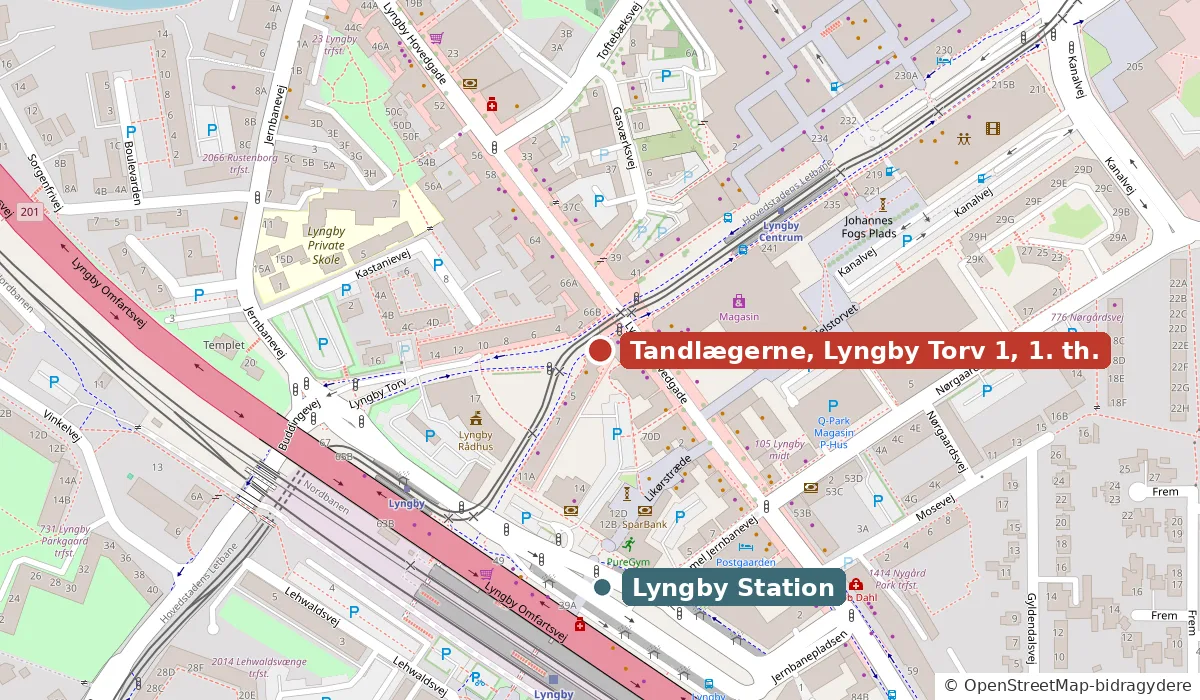
The map is only loaded from Google when you tap. Google may then set cookies. Read more.
Image: © OpenStreetMap contributors